FB HEADER

Search The Rusted Garden Journal: Just Enter a Key Word or Phrase

Sunday, December 2, 2018

34 Vegetable Plants You can Grow in Less Sunlight or More Shade: Full Sun, Partial Sun and Minimal Sun Categories Defined

The Rusted Garden Seed and Garden Shop

34 Vegetable Plants You can Grow in Less Sunlight or More Shade: 
Full Sun, Partial Sun and Minimal Sun Categories Defined


Does my garden have less sunlight or more shade? Growing vegetables is not difficult but it does take work and we (gardeners) at times, make it more confusing and complicated than needed. The beauty of a garden is that it wants to grow and give back to you. Nature designed plants to adapt. Even if you initially have some trouble, you will still get plenty of vegetables as you develop your skills and abilities over the seasons. The best way to grow vegetables is to start planting and enjoy learning as you go. That is what my YT channel The Rusted Garden is all about. Please subscribe and check out a few of my 800+ gardening videos. 

It is is important to understand the basic needs of the vegetable plants you want to grow in your garden.  The amount of sunlight is a great place to start. Sunlight is, of course, needed for your plants to flourish but not all vegetable plants need the same amount of direct sunlight.  Many people think they can't have a vegetable garden because they don't 8 plus hours of sun on their property. You can grow and harvest vegetables with 'Less Sunlight or More Shade' than you might have thought possible.

Direct Sun Requirements for Vegetable Plants Vary - The Rusted Garden

The first thing that is important to understand is that vegetable plants want to grow and are adapted to grow within a broad range of their required needs. They can easily be placed in more than one arbitrary category for sun requirements because they are designed to adapt and do well in a range of sunlight.  So the key word is range and I stressed it three times.  The bottom line is to try different plants in different places of your garden. You will be surprised by what plants grow in the lower range (4 times) of sunlight and often even do better without all the sun they were getting.

Kale Does Well in Partial Sun - The Rusted Garden

There is no set universal 'title' for each category of light. You will find; full sun, partial sun, partial shade, light shade, deeply shaded or shade as categories when you do research. You will find terms like direct, indirect, dappled and reflected sun. I am just presenting how I look at lighting needs for my vegetable plants, which is basically a 'range' of direct sun. Direct sun is where the sun directly hits plant leaves.  That is the type of light, direct sun. I feel this is the least complicated way to identify where the heck to plant your plants... type of light (direct sun) and number of hours of direct sun (5). 

Vegetable plants are generally classified into 3 groups when you do research: Full Sun, Partial Sun and Light/Partial Shade.  I think this is confusing as you can have Partial Sun or Partial Shade. Isn't that the  same? It is like saying it is Partly Sunny or Partly Cloudy outside.  The bottom line is your garden must have sun. It can be, for instance, 8 hour of continuous sun or 4 hours of morning sun and 3 hours of late afternoon sun.  Because a vegetable garden must have direct sun for plant photosynthesis, I use these three 'Sun' categories below.


Full Sun (6-8) is a minimum of 6 hours but the plants in this category really do their best with a full 8 hours. Of course more than 8 hours works but some plants can get beat up by intense hot summer sun, come the long days and heat of July and August, in my zone.

Partial Sun (4-6) is a solid minimum of 4 hours and they enjoy a range of direct sun that covers a span of 4-6 hours.  7 hours would be okay.

Minimal Sun (2-4) plants need a lot less direct sun but 2 hours is a really low.  You will notice a clear difference in growth between plants that only get 2 hours of sun and the same plants that get the 4 hours of sun.  The lower range of 2 hours is pretty challenging.

Beets Do Their Best in Partial Sun - The Rusted Garden

Here are 34 plants that can do well in Partial Sun (PS) and in some cases somewhat decently in Minimal Sun (MS).  A general rule of thumb is that leafy green plants used for salads can do better with less sun. I will be growing most of these plants in 2019. I have videos on garden bed design, seed starting, planting, tending and harvesting. If you would like to learn more... follow me at The Rusted Garden. The vegetable plants have active links that take you to my secure Vegetable Garden and Seed Shop hosted on Shopify.

Arugula PS MS
Beans PS
Beets PS
Celery PS
Endive PS MS
Escarole PS MS
Garlic PS
Kale PS
Leeks PS
Peas PS 
Radishes  PS MS
Rutabagas PS MS
Scallions PS MS
Sorrel PS
Spinach  PS


Subscribe to my YouTube Channel The Rusted Garden
Over 800 Garden Videos Designed to Quickly Present Information!

Please support The Rusted Garden - Thanks!

By using these Amazon links, any purchase you make returns a % of sales back to TRG. I turn most of that back into the garden and videos. Greatly Appreciated! - Gary (TRG)
The Rusted Garden Amazon Direct Link

Seed Starting Supplies:
Garden Fertilizers:
Amazon General Search Page:

Friday, November 23, 2018

Join Me in 2019 and Watch Me Transform 2 Acres into My Partially Off-Grid, 1/2+ Homestead, 90% Organic Farmette: Wait What?

The Rusted Garden Seed and Garden Shop


Join Me in 2019 and Watch Me Transform 2 Acres Into
My Partially Off-Grid, 1/2+ Homestead, 90% Organic Farmette: Wait What?


My wife and I will be moving to a couple of acres and I will be transforming it from open space into... Wait, let's take a minute to define a few terms that are getting tossed around like hot potatoes.  What exactly does 'Off-Grid' mean. Well technically, no power, no water, no internet, no dependence on services coming into your house. You would not be connected to private or public utilities (gas, water, electricity, again the internet).  You rely on yourself, family and the community and nothing is coming into your home but that which you haul in from the wilderness or build. I'm just saying that is the traditional definition.


Well, I am not doing that as that sounds awful as defined. However, I am going to reduce my dependence as much as I can from the grid. So I am going somewhat partially 'Off-Grid'.  I am aiming for a reduction of reliance on the grid. After all, I have a YT Channel. 'Off-Grid' means good bye, in theory, unless you are my neighbor, who would probably be like 2 miles away.  I just enjoy interacting with gardeners from around the globe.  The internet stays.

I am going to be working a farmette as I can't swing managing a farm and I want to practice 'homesteading' on my 'homestead'.  Can I do that without feeling badly about myself? Of course, I can and I want to encourage all of you to take bits and pieces of all these amazing ideas you find on homesteading & farming YT Channels and apply them in a way that improves the quality of your lives.  


Old Wood for a New Chicken Coop: The Rusted Garden

My kids are in their twenties. I am looking for a place where I can grow my own food, raise some chickens, build and shape the land as I wish and create a homestead for my adult kids, their grand children (down the line), family and friends.  A place to simply enjoy life and what the earth gives to us. 'Homesteading' is used today and defined as living a life of self-sufficiency. Doing things like growing your own fruits and vegetables, raising some animals, preserving food,  maybe making your own clothing & crafts and generally being reliant on yourself and your family.  I like that perspective but just not all of it. 

Well, I am interested in about 1/2 of the above. I want to be more self sufficient and know the source of my food. I want to build and create on my land and rely on my  hard work.  Can I still be a 'homesteader'?  Of course I can, at 52 I don't define myself, I just be myself. I invite you to join me, and follow along as I build my homestead.  My YT channel is The Rusted Garden. I have 800 gardening video there but come 2019, I will be building my partially off-grid 1/2+ homestead with the first dig of the ground to build my first new garden bed. I will be creating videos for every step of my adventure and land transformation.


2nd Year Blueberries Ready to Produce in 2019: The Rusted Garden

Are my gardens going to be 100% organic all the time, forever? Nah, but pretty close. Or do you mean will I be buying supplies that are stamped, marked, certified and proven to be 100% organic before I use them in my soil? Nope. 'Organic' has truly gotten out of control. Mostly around fertilizers. Is organic good in principle? Yes it is 100% but the commercialization of the word 'Organic', is bad.  Just be wise when shopping for organic products. A lot of things are not as organic as you think and you pay a lot more than is fair. But that is the theme of another future blog article. 

I am on my soapbox a bit. So here we go... all things on the planet are chemicals which includes organic fertilizers.  Some fertilizers occur naturally (but are still chemical compounds), get changed by Nature and microbes and your plants use the finished products made by the microbes. Some fertilizers are made by people and those products get a bad wrap as toxic and deadly and they are called chemical fertilizers. They are not all made the same and they don't all come from petroleum. 

They aren't toxic or deadly. Obviously don't mix them with your lemonade. But they won't hurt your plants or poison you when you eat the plants. If microbes can transform chemical compounds into fertilizers, why can't we? They are just different and being different is okay. However... compost is king.  Why are we even discussing this?


Compost is Free to Make: The Rusted Garden

You don't need any of the above if you just compost leaves, grass, chicken poop and such. See, we have been tricked into to  predominately buying, yes buying, organic fertilizers. That's not self sufficient but I know that might be your only option for now.  We have been told by some that human made fertilizers are pretty much deadly which is wrong. And why we argue, we forget that compost is free to make and it is how Nature has been feeding the earth from the beginning. 

On my new farmette, I plan to make tons of compost. Hot compost, cold compost and just right compost. While that is happening or when needed, I'll buy mostly organic fertilizers and use water soluble human made fertilizers as needed. As far as pesticides go... don't put anything on your plants that you don't fully understand both what it is and what it does.  Just because it is stamped organic, it does not mean it is not toxic or harmful to people or animals in some way. That is really important to remember.  Okay, so 90% organic. 

At 52, if I learned anything, I learned you don't have to be 100% anything to enjoy your life.  I invite you to come along on my adventure as I build my partially off-grid 1/2+ homestead 90% organic farmette on about 2 acres of land.  I will take you from building your first garden bed all the way through cooking what you produced on your land, around your home. And every step in between!

Good Luck in Your Gardens

Gary (The Rusted Garden)


Subscribe to my YouTube Channel The Rusted Garden
Over 800 Garden Videos Designed to Quickly Present Information!

Please support The Rusted Garden - Thanks!

By using these Amazon links, any purchase you make returns a % of sales back to TRG. I turn most of that back into the garden and videos. Greatly Appreciated! - Gary (TRG)
The Rusted Garden Amazon Direct Link

Seed Starting Supplies:
Garden Fertilizers:
Amazon General Search Page:

Where to Dig Your First Vegetable Garden: All the Basics for a Great Start!

The Rusted Garden Seed and Garden Shop

Where to Dig Your First Vegetable Garden: 
All the Basics for a Great Start!


Welcome to the world of vegetable gardening! The first step toward a successful garden is selecting the right location.  You want a space that has a southern exposure to the sun. Remember the sun rises in the east and sets in the west. All in all, you want a minimum of 6 full hours of direct sun but 8 to 10 hours of direct sun will really meet the growing needs of all your plants.  Direct sun means a direct path from the sun to your plants.  Indirect light from the sun does not count. If your plants were to look up, they would see the sun for 6-10 hours directly shinning on them.  More sun is okay of course.

Using A Compass to Dig a Garden: The Rusted Garden

The best way to generally figure this out is by using a smart phone or a compass. You can use any compass application.  The key is to go out into your yard at noon on a fully sunny day. You want to see where the sun is hitting your yard at 12 PM. Remember trees without leaves, leave little shade.  We often start gardens before tree leaves appear. Trees have to be imagined with all their leaves on.


Look for Potential Shadows When Digging a Garden: The Rusted Garden

Go to the sunniest area  or the area you want for a garden and start the compass. You want to face directly south. That means your left side will be east and your right side will be west. Look east and imagine the sun rising and tracking from your left to right as it would set in the west. Since you are facing south, that is the space/path the sun will track. Look for trees and obstructions and recognize where shadows will fall on you garden.  This is a great way to start thinking about your garden placement.

If you have trouble with this concept or perhaps have some shade obstacles, you can also try this method. Pick the space as described above but also do a check on it the next day. Go out to the same spot at 10 AM, 12 PM, 2 PM and 4 PM. That covers an eight hour span. You can visually note if the sun is on the proposed garden spot during those times. Remember, you need 6-10 hours of direct sun. If shade falls on the garden during some of that time between 10-4, that is okay. You don't need continuous sun but do need the appropriate amount of hours  (in total) for your garden to flourish. 


6 to 10 Hours of Direct Sun: The Rusted Garden

Two things that are hard to correct are total hours of direct sun for obvious reasons and soggy soil. The latter can be addressed with some hard work. However, I also recommend making notes when storms come to your yard. Look to see where the storm run-off goes and where water sits. You want your garden to be in a place that drains quickly. What does that mean?  Puddling water should be gone from that area  in a couple hours after the storm ends.  Soggy soil, where water sits in the root zone, typically causes root rot, oxygen problems and other issues.  You don't want to dig 24 inches into your garden beds and see pooling water. Water should quickly drain deeply away into the soil after a couple hours.

These are the two basic concerns to address when you look for space to dig your first vegetable garden.  If you can check off the boxes - full sun and drains well... that is the perfect place to start your journey into the world of vegetable gardening!

Good Luck in Your Gardens

Gary (The Rusted Garden)


Subscribe to my YouTube Channel The Rusted Garden
Over 800 Garden Videos Designed to Quickly Present Information!

Please support The Rusted Garden - Thanks!

By using these Amazon links, any purchase you make returns a % of sales back to TRG. I turn most of that back into the garden and videos. Greatly Appreciated! - Gary (TRG)
The Rusted Garden Amazon Direct Link

Seed Starting Supplies:
Garden Fertilizers:
Amazon General Search Page:

Sunday, November 11, 2018

How to Easily and Cheaply Build A Vegetable Garden Grow-Light Closet: Part One - What Kind of Lights Do I Need (Kelving and Lumens)?

The Rusted Garden Seed and Garden Shop

How to Easily and Cheaply Build A Vegetable Garden Grow-Light Closet:
Part One : What Kind of Lights Do I Need (Kelvin and Lumens)?


I will be doing a series on my YouTube Channel, through the beginning of 2019, that takes you through all the steps of building your own vegetable garden grow-light closet. Follow my blog and channel for the next entries!

The first question to ask is: What Kind of Lighting Do I Need to Grow My Own Vegetable Seed Starts and Transplants?  The answer is expressed in Kelvin and Lumens. I will explain those terms in detail but they are basically light color and light intensity. Once you understand these terms and ratings, you can buy bulbs and receptacles/fixtures yourself and save a lot of money. There is no need to buy specialized grow-lights for seed starting and transplants. They just cost more.


Basic Grow-Light Bulbs and Fixtures: The Rusted Garden

Let me talk briefly about the importance of the right amount of light which I will detail more in future entries. The bottom line is you need 12-16 hours of direct light on your seed starts and transplants for healthy growth. Most windows do not provide this as they provide indirect light. Direct light means the sunlight is coming from the sun to the plants in a direct line. You can see the sun from the window.

Windows rarely provide enough light and you end up with tall, spindly, weak looking plants. This problem is called ‘leggy’ plants or plant ‘legginess.’ That’s too much stem (or leg) and not enough bushy leafy top growth. This can  also happen with the wrong indoor lighting. Therefore, you really need indoor grow lights with a specific Kelvin and Lumens ratings to have success.

The goal is to grow healthy seed starts and transplants. You don’t need specialized expensive grow lights. You don’t need red, blue and white lights. You just need to address two factors associated with your lights/bulbs. That is the Kelvin rating and Lumens rating on the lights. It is the same for LED lights and fluorescent lights. If you were growing indoors plants to flower and fruit, you would need specialized lighting systems. My video not only explains the details needed for building your grow-lights, I also take you shopping to find the products you will need.


The Kelvin and Lumens ratings can be found on the bulb packaging. If you can’t find it, don’t use those bulbs. The Kelvin scale represents the color or type of light. You want a Kelvin (K) rating of 4000K to 6500k as that represents the color of light when the sun is at its highest point, which is more white. I recommend a minimum of 5000K. 6500k is the best (as it is full daylight). I have been successful (years ago) using 4100K bulbs if that is all you can find. However, 6500K LED and fluorescent bulbs are now easier to find and less expensive in today’s markets. You want the whitest light possible, the lower the Kelvin rating, the more yellow the light. The top lights in the picture below are rated at 6500K. Notice how white that light is compared to the yellow light of the 4100K rated bulbs in the lower part of the picture.


Kelvin Rating Grow-Light Color Differences - The Rusted Garden


Lumens represent the intensity of the light. It makes sense that you want intense light as that is what helps your seed starts mature. You will need 2000 to 5000 lumen bulbs for your grow lights. I have used bulbs over the years that have been rated between 2000-3000 lumens and they have worked effectively. That is the most common range you will find.

Over the last several years higher lumen LED and fluorescent lights have become more common and less expensive. I now recommend a minimum of 3000 lumens when possible. I have not used bulbs beyond 5000 lumens. They work extremely well. The more lumens you have the greater the distance the lights can be from the seed starts. In future blog entries I will talk about how close the lights need to be to your seed starts and transplants.


Basic Fluorescent Bulbs and Fixture - The Rusted Garden

LED System - The Rusted Garden


You can use LED lights or fluorescent lights. They key to success is the right Kelvin and Lumen rating ranges. You can buy lights based on your budget. LED's are more expensive but use less power. I recommend 4 foot fluorescent bulbs or 4 foot LED systems. This length provides the coverage of light needed for healthy seed starts. Check out the above video for more information and a visit to a couple of stores where you can buy bulbs and fixtures. Please subscribe to my YouTube Channel: The Rusted Garden and follow my blog!

Good Luck In Your Gardens,
Gary (The Rusted Garden)

Subscribe to my YouTube Channel The Rusted Garden
Over 800 Garden Videos Designed to Quickly Present Information!

Please support The Rusted Garden - Thanks!

By using these Amazon links, any purchase you make returns a % of sales back to TRG. I turn most of that back into the garden and videos. Greatly Appreciated! - Gary (TRG)
The Rusted Garden Amazon Direct Link

Seed Starting Supplies:
Garden Fertilizers:
Amazon General Search Page:

Sunday, November 4, 2018

11 Tips for Successfully Planting Garlic in Your Vegetable Gardens


11 Tips for Successfully Planting Garlic in Your Vegetable Gardens

Garlic is really easy to grow once you figure out the basics. Here are 11 tips to get you started growing garlic in your vegetable gardens. The video covers and demonstrates all 11 tips.

11 Tips for Planting Garlic: The Rusted Garden

Tip 1:  Garlic does not like to sit in water or prolonged wet soil. Make sure your garden soil drains well and water doesn't sit in or pool to that area of your garden. I plant my garlic in 12 inch raised beds. This is probably the most important tip to successfully growing garlic in your garden.

Tip 2:  Rotate garlic to a new planting area every 3-4 years. Garlic can be susceptible to rot. Even if you are growing in well drain soil to minimize issues, rot can come to your garlic cloves. Rotation is the best way to practice good garlic garden hygiene.

Tip 3:  Garlic cloves will form garlic bulbs. Make sure your garden soil is really loose to a depth of 6-12 inches. You want garlic roots to easily penetrate into the soil and you want the plant to be able to easily push through the soil as the bulbs forms and expands. You may need to add sand, coco coir, compost or peat moss to loosen heavier soils.

Tip 4:  Garlic prefers a pH of 6-7. Most garden soils sit between 5.5 and 6.5. If you use compost regularly, your garden beds are most likely in that 6-7 range. You can raise the pH of soil by adding lime to the planting area. If you are having problems growing garlic, it would be a good idea to test the pH of your soil.

Tip 5:  There are basically two categories of garlic called hardneck and softneck garlic. The are many different garlic varieties that fall into these two categories. The best way to see what your zone is best suited for is to do a quick search on garlic zones.  Here in Maryland Zone 7, I can growth both types but have found hardneck garlic seems to do the best out of the two. There are hundreds of different varieties you can grow.

Garlic Spacing and Planting Depth: The Rusted Garden


Tip 6:  Don't over fertilize you garlic beds. It most cases there is plenty of fertilizer already in your soil from the season. A basic organic granular 5-5-5  NPK fertilizer is best. Garlic is a bulb and therefore people often think you need more phosphorous. However, garlic also likes nitrogen. A 5-5-5. will cover all the needs of garlic. I lightly fertilize at planting and come early spring, I give them a big drink of a balanced water soluble fertilizer.

Tip 7:  Garlic needs a cold period or a stratification period. Planting garlic in the fall provides the cold period it needs. I plant my bulbs between October 15th and November 15th. This will vary somewhat based on your Zone. The key is to get them in the ground before it freezes but not so early that they stay warm and begin over growing.

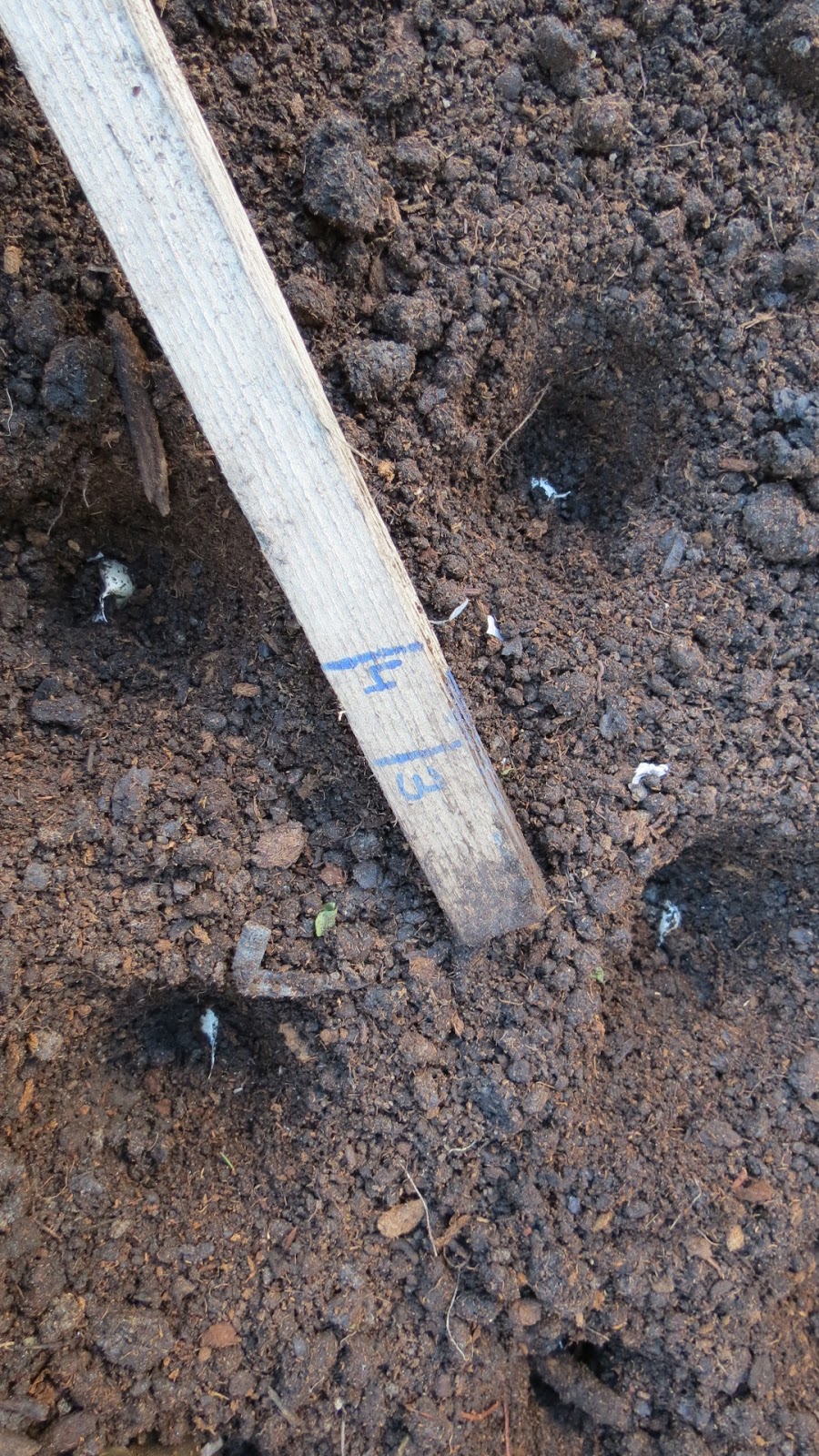
Tip 8: Mature garlic bulbs will form to different sizes based on the variety you purchase.  A general rule of thumb that works is to plant them 3-4 inches deep and space them 4-6 inches apart. You can experiment with this and see what works best in your Zone for any specific variety.


Tip 9:  You can plant garlic deeper as you get into colder zones. The key is to plant them below the freeze depth of your soil. You don't want a clove to freeze solid.  But you don't have to always go deeper. You can add several inches of mulch to your planting beds. You can use straw, hay, leaves or shredded hardwood. As spring approaches, remove the mulch.

Tip 10:  Nature is amazing. There is a top and bottom  to garlic cloves. If you can't figure it out, just plant the clove on its side and it will take care of itself.

Tip 11:  Don't water your garlic in. Just leave it alone until the spring. If it stays warm, you might get several inches of green shoots that will yellow and die when the freeze of winter arrives. Don't worry about it. Just let the garlic chill for the fall and winter. The root system will be growing in the ground. That is all that matters.


Subscribe to my YouTube Channel The Rusted Garden
Over 800 Garden Videos Designed to Quickly Present Information!

Please support The Rusted Garden - Thanks!

By using these Amazon links, any purchase you make returns a % of sales back to TRG. I turn most of that back into the garden and videos. Greatly Appreciated! - Gary (TRG) The Rusted Garden Amazon Direct Link

Seed Starting Supplies:
Garden Fertilizers:
Amazon General Search Page: